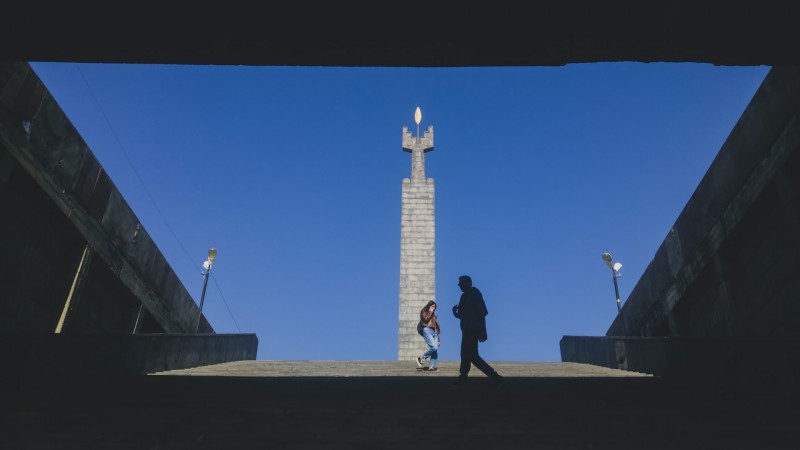
Yerevan’s compact network makes it easy to reach major museums, monuments and viewpoints without a taxi. Here’s how to travel between the headline sights with clear, practical routes.
Tsitsernakaberd Armenian Genocide Museum
The most devastating chapter of Armenian history is the murder of an estimated 1.5 million civilians by the Ottoman authorities in 1915. The museum’s exhibitions weave personal testimonies with the wider political events that continue to shape modern Armenia.
Getting there: From Pak Shuka (also known as Blue Mosque), take buses No. 26, 27, 33 or 63. The stop is in front of the shopping centre.
Matenadaran
The Matenadaran is a major repository of Armenian literature and manuscripts, with thousands of works spanning religion and theology, astronomy and cosmology, philosophy, and the writings of classical and medieval historians.
Getting there: It’s about a 10-minute walk from France Square (Opera House) and a similar distance from Yeritasardakan metro station.
Yerablur
This hillside cemetery is the principal resting place for soldiers who died during the Artsakh War and subsequent border conflicts.
Getting there: From France Square or Pak Shuka, take bus No. 47. You can also take bus No. 53 from Yeritasardakan metro station, Vardan Mamikonyan (Vernisage) or Spartak Stadium (Zoravar Andranik metro station).
Karmir Blur
Once a provincial capital in ancient Armenia, Karmir Blur is a low hill with the ruins of a fortress still visible.
Getting there: First travel by metro to Garegin Nzhdeh Square. From there, take bus No. 4 to Karmir Blur (the route terminus).
Erebuni Museum & Fortress (Arin Berd)
Founded in the 8th century BCE atop Arin Berd hill, Erebuni includes a museum whose artefacts illuminate daily life in the citadel. The fortress itself is open to visitors and rewards the short climb with broad views.
Getting there: From France Square, take buses No. 1, 18, 37 or 58. You can also take trolleybus No. 2 from Zoravar Andranik.
Victory Monument & Mother Armenia
A popular lookout crowned by the Mother Armenia statue. It honours the prominent female figures in Armenian history — such as Sose Mayrig — who took up arms alongside their communities in turbulent late-19th and early-20th-century conflicts. On clear days the panorama stretches across the city centre and beyond.
Getting there: Walk up from the Cascade complex, or ride buses No. 10, 29 and 46 from Yeritasardakan or buses No. 23 and 24 from France Square.
Etchmiadzin (Vagharshapat)
Often called the Vatican of the Armenian Church, this extensive complex includes one of the world’s oldest cathedrals (dating to the 3rd century AD), two museums, formal gardens and the headquarters of the Armenian Apostolic Church. It’s a compelling day trip from the capital.
Getting there: From Kilikia bus station, take bus No. 203. The journey is about 30 minutes depending on traffic.